









02 Jul The Role of Slide Gates in Managing Flow in Treatment Plants
Slide Gates and Sluice Gates in Wastewater Treatment Facilities
Most people never think about what happens after they flush a toilet or send water down a drain. Behind the scenes, wastewater treatment facilities work around the clock to remove solids, contaminants, and harmful pathogens before clean water is safely returned to the environment.
What many people don’t realize is that this entire process depends on precise flow control. At nearly every stage of treatment, operators must direct, isolate, stop, or regulate water movement. That’s where slide gates, sluice gates, and weir gates become essential components of the treatment process.
Controlling Water Through Every Process
For decades, Whipps, Inc. has supplied custom-fabricated water control equipment to wastewater treatment facilities throughout North America, helping operators maintain efficient and reliable treatment operations.
Managing Flow from Collection Systems to Treatment Plants
Wastewater begins its journey through a network of underground sewer pipes that transport water from homes, businesses, and industrial facilities to a treatment plant. Before treatment can begin, operators must have the ability to isolate pipelines, redirect flow, and perform maintenance on critical infrastructure. This is where sluice gates play an important role.
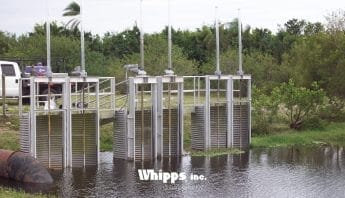
Installed in pipe systems, tunnels, and large conduits, sluice gates act as mechanical barriers that can stop or regulate flow when necessary. Many wastewater facilities utilize embedded-mounted sluice gates that are cast directly into concrete structures, providing a durable and dependable solution for long-term service. These gates allow operators to safely isolate sections of a facility, perform maintenance, and protect equipment during emergencies.
Supporting Primary Treatment Operations
Once wastewater enters the treatment facility, it moves through screening and grit removal systems before entering primary settling tanks. In these large circular basins, heavier solids settle to the bottom while oils and lighter materials rise to the surface. The goal is to separate as much material as possible before the water moves to the next treatment stage.
Slide gates and sluice gates help operators control flow into and out of these treatment areas while allowing individual basins to be isolated for cleaning, maintenance, or repairs. Without reliable flow control equipment, facilities would struggle to maintain treatment efficiency while keeping operations running.
Controlling Water Levels During Biological Treatment
After primary treatment, wastewater typically enters biological treatment basins where microorganisms break down dissolved organic matter. Maintaining proper water levels throughout this process is critical. If water levels become too high or too low, treatment efficiency can suffer.
This is where weir gates or downward-opening slide gates often become essential. These gates allow operators to regulate water elevations and direct flow between treatment basins while preventing cross-contamination between different stages of the process. Precise water level control helps ensure that each treatment stage performs as intended and that the water receives adequate treatment before moving forward.
Flow Control Through Final Treatment and Discharge
As wastewater progresses through secondary clarification and final treatment processes, additional slide gates and sluice gates continue to direct flow through the facility. These gates help operators isolate tanks, manage changing flow conditions, and maintain operational flexibility throughout the plant.
By the time water reaches the discharge stage, it has undergone multiple treatment processes designed to protect public health and the environment. The reliability of the water control equipment used throughout the facility plays a direct role in helping treatment plants consistently meet regulatory requirements.
Built for Long-Term Wastewater Service
Wastewater environments are among the most demanding conditions for mechanical equipment. Constant exposure to moisture, chemicals, and corrosive conditions requires materials that can withstand decades of service. Whipps, Inc. manufactures slide gates and sluice gates from corrosion-resistant aluminum and stainless steel designed specifically for these challenging environments. Our custom-fabricated gates are engineered to meet project-specific requirements while providing low leakage, reliable operation, and long service life. Whether installed at the headworks, primary clarifiers, biological treatment basins, or final discharge structures, Whipps gates help wastewater facilities maintain control over one of their most important resources: water.
Supporting Cleaner Water for Our Communities
Every wastewater treatment plant depends on reliable flow control equipment to operate effectively. From the moment wastewater enters the facility until treated water is safely returned to the environment, slide gates, sluice gates, and weir gates help guide the treatment process every step of the way. At Whipps, Inc., we are proud to provide the custom-engineered water control solutions that help wastewater professionals protect public health, preserve water quality, and keep critical infrastructure operating efficiently.